



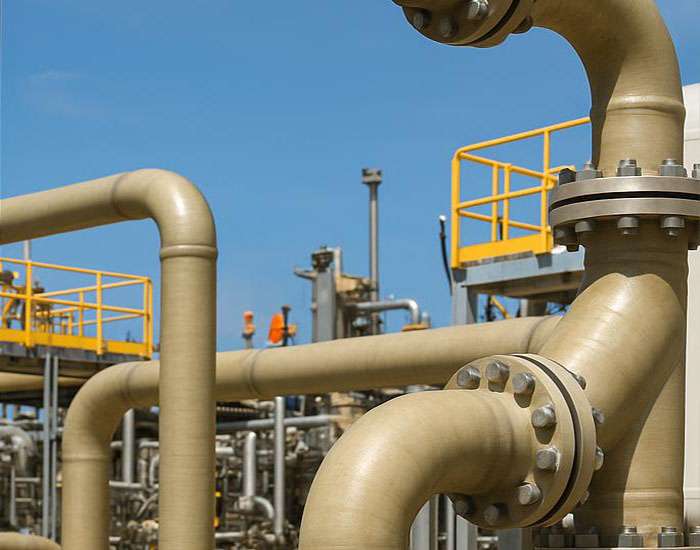
The oil and gas industry demands pipelines that withstand corrosive fluids, harsh conditions, and high pressures. Fibre-reinforced plastic (FRP) pipes, also known as fibreglass tubes or composite pipelines, offer a lightweight, durable, and corrosion-resistant alternative to steel and concrete. Engineered from glass fibres and polymer resin, FRP systems are ideal for offshore platforms, sour gas environments, and high-salinity operations, delivering lower installation costs and long-term lifecycle savings.
Key Advantages of FRP Piping
FRP piping systems offer multiple technical and commercial benefits over conventional steel or concrete pipelines. Key advantages include:
Exceptional corrosion resistance. The glass-reinforced polymer matrix is inherently immune to rust. FRP stands up to acids, alkalis, salts and sour gas components that quickly attack steel. In corrosive environments (e.g. offshore seawater, CO₂/H₂S-laden gas), FRP retains its structural integrity while steel rapidly deteriorates. This means years of reliable operation without wall thinning or costly leak repairs.
Lightweight construction. Glass-fibre pipes weigh roughly 80% less than equivalent steel pipes. This dramatic weight reduction simplifies handling, shipping, and lifting. In one case, a 36-inch FRP pipeline installed for an oil-sands project was 80% lighter than steel, cutting shipping costs by 45% and allowing faster installation without heavy cranes. The low weight also enables longer lengths and larger diameters to be used in remote or offshore installations, reducing joints and fit-up work.
Long service life and reliability. FRP’s superior durability means much longer intervals between replacements. Extensive field data show that FRP pipelines have lasted decades in aggressive service. For example, FRP brine lines in desalination plants showed virtually no degradation after 15 years, whereas comparable steel systems required replacement in 6–8 years. Industrial studies confirm that even with higher upfront costs, total ownership costs of FRP can be 40–60% lower over 30 years due to its longevity.
Low maintenance costs. The inherently smooth, non-metallic interior of FRP pipes resists scaling and biofouling. Unlike steel, FRP requires no cathodic protection or periodic recoating. In practice, this eliminates major maintenance expenses. For instance, research has shown that FRP municipal pipelines need only occasional inspection (costing a few hundred thousand pounds over 20 years) compared to the maintenance of multi-million-pound steel lines. FRP piping can reduce long-term maintenance spending by 40% or more than steel in corrosive settings.
High flow efficiency. Glass-lined FRP pipes have very smooth walls, minimising friction losses. This high hydraulic capacity means smaller pumps or fewer pumping stations are needed for the same throughput. In addition, FRP’s non-corrosive interior prevents roughness buildup over time, ensuring stable flow and minimising energy costs.
Engineering versatility and safety. Composites can be tailored to application needs. FRP pipes can meet specific pressure, temperature, and fluid compatibility requirements by choosing different fibres and resin systems. FRP is nonconductive and nonmagnetic, preventing galvanic corrosion and electrical hazards. It also exhibits a “leak-before-break” failure mode, warning operators of small leaks rather than sudden rupture. These safety and customization features make FRP an attractive choice for critical oil and gas systems.
Collectively, these benefits give FRP piping a strong lifecycle cost advantage. Even if material costs are ~20–30% higher than steel initially, analyses show 30-year lifecycle costs can be up to half as much. This means decision-makers will have a lower total project cost and risk over the plant’s life.
Applications in Challenging Oil & Gas Environments
FRP and fibreglass tubing are dused in the toughest oil & gas applications thanks to these properties thanks to these properties. Notable use-cases include:
Offshore Platforms (Saltwater Service). Offshore installations face constant saltwater corrosion. FRP’s inertness to salt makes it ideal for seawater handling, injection, and firewater systems. For example, North Sea oil platforms now use FRP pipes for firewater to avoid the severe corrosion that plagued carbon steel systems. The reduced weight of FRP also lowers deck load and crane requirements during construction.
Sour-Gas Processing (H₂S Exposure). Pipelines carrying hydrogen sulfide (H₂S) and CO₂ present extreme corrosion challenges. Specialised pipes with epoxy-vinyl ester resins have proven highly resistant to H₂S attack. Industry experts note that FRP pipes made with these resins (e.g. DERAKANE® 411) have been used successfully for years in sour-gas service. This allows FRP to be used for sour gas gathering lines, amine acid gas injection, and other corrosive services where steel would rapidly fail.
High-Salinity Water & Brine Lines. Produced water and desalination streams are rich in chloride and sulfide, which destroy steel. FRP excels in these high-salinity fluids. For instance, a Saudi Arabian study found steel lines in desal plants needed replacement every 6–8 years due to salt corrosion, while FRP lines showed no measurable damage after 15+ years. As a result, FRP is widely adopted for handling seawater, fracking water disposal, and other saline fluids in oilfields.
Acid and Chemical Injection Lines. Refineries and gas-processing plants use FRP for pipelines carrying aggressive chemicals (e.g., sulfuric acid, caustic, and chlorides). FRP’s excellent acid resistance suits it for ph-swing amine systems, acid gas sweetening, and sulfuric acid pumps. Using fibreglass tubes in these lines avoids the recurrent pickling and maintenance needed for metal pipes.
Onshore and Pipeline Projects. In remote or land-based projects, FRP’s lightweight significantly reduces transport and handling costs. Long straight sections of FRP pipe can be offloaded and set without heavy lifting gear. FRP’s nonmagnetic nature also avoids interference with downhole instruments or cathodic-anode systems used on steel pipelines. Fop’s smooth flow and low friction can minimise pumpminimizewer.
Composite pipeline solutions match and exceed steel’s performance in all these scenarios. FRP’s unique toughness, flexibility, and immunity to specific corrosion modes make it especially valuable in niche applications critical to modeoil and& gas projects.
JMFRP: Industry-Leading FRP Solutions
In this specialised field, a reputable FRP manufacturer is crucial. JMFRP is a professional manufacturer of FRP materials with decades of expertise in composite piping. JMFRP’s facilities use advanced filament-winding, pultrusion, and continuous-cast processes to produce high-quality fibreglass piping systems tailored to oil and gas needs. Every JMFRP pipe is engineered with the correct resin/fibre formulation (polyester, vinyl ester, epoxy, etc.) and pressure rating for the intended fluid and environment.
Quality assurance is ingrained in JMFRP’s manufacturing. Their FRP products are built under strict ISO 9001 guidelines and tested to industry standards (ASTM, ISO, DIN). As a result, project engineers can trust JMFRP’s composite pipelines to deliver uniform wall thickness, precise dimensions, and certified strength. JMFRP offers a full range of fibreglass tubes and fittings – from small-diameter instrumentation lines to large-diameter double-containment pipelines – with the technical support to specify the right system.
Whether supplying corrosion-resistant firewater mains on an offshore platform or corrosive acid-gas injection lines at a refinery, JMFRP’s products are optimised for long-term performance. By partnering with JMFRP, operators gain access to FRP expertise (material selection, joint design, installation training), ensuring each FRP pipeline performs reliably under the harshest oil and gas conditions.
Conclusion: Embracing Composite Pipelines
Lightweight FRP piping systems have proven their worth in critical oil and gas projects. Combining high strength and corrosion resistance, FRP pipelines withstand the toughest sour-gas, saltwater, and chemical exposures. This translates to longer service life and much lower maintenance costs than steel. For example, even though FRP may cost 20–30% more upfront, industry analyses show total 30-year costs can be 40–60% lower due to fewer shutdowns and repairs.
As operators seek higher reliability and lower lifecycle costs, FRP and fibreglass tube solutions are rapidly gaining acceptance. When carefully engineered and installed by experts like JMFRP, composite pipelines deliver a durable, cost-effective alternative for corrosion-intensive applications. In short, lightweight FRP piping is a proven, mature technology that offers technical excellence and economic value, making it an ideal choice for forward-looking oil and gas projects.

