



FRP (fibre-reinforced plastic) – typically fibreglass in a polymer matrix – is naturally an excellent electrical insulator. Glass fibres and standard resins (epoxy, polyester, vinylester, etc.) have very high resistivity, on the order of 10^15–10^18 Ω·cm. This makes FRP ideal for insulating applications (utility poles, switchgear panels, circuit-board backplanes, transformer supports, etc.). For example, FRP switchboard barriers and arc shields often use an electrical-grade resin (like melamine) that gives outstanding dielectric strength and self-extinguishing properties. In short, standard fibreglass rod, tube and sheet products (such as JMFRP’s pultruded profiles) provide very high dielectric strength and protection for electrical and electronic components.
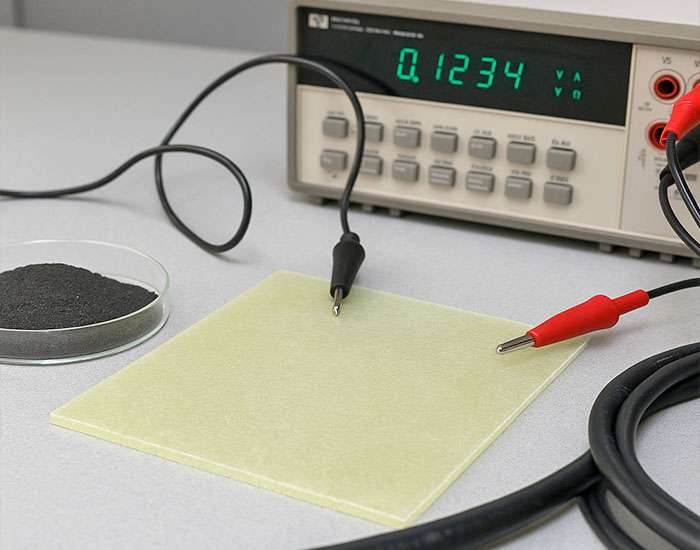
However, there are exceptional cases where some conductivity is desired – for static dissipation, EMI shielding, or lightning protection. Conductivity can be “tuned” by adding conductive fillers to the resin. The composite remains an insulator at low filler content, but a continuous network of conductive paths forms above a critical percolation threshold. Beetle Plastics explains, “at a specific concentration of conductive filler, electro-conductive channels are formed and the insulators are turned into semi-conductors”. Adding even a few weight per cent of highly conductive particles or fibres can change FRP’s electrical properties by orders of magnitude. (For instance, one patent shows glass-FRP with 1–30 wt% conductive filler achieving surface resistivities from about 10^9 down to 10^1 Ω/sq.)
Conductive Fillers and Their Trade-offs
A variety of conductive fillers are used, each with pros/cons for conductivity, mechanics and cost:
Carbon Black & Graphite: Common, low-cost fillers. Finely divided conductive carbon black can be added to high loadings of plastic to create conductive paths. Graphite flakes or fibres also conduct well when loaded heavily (typically 10–30 %+ by weight). Graphite gives high conductivity but is anisotropic (conducts much better along the flake planes). These carbon fillers are suitable for antistatic FRP (reducing surface resistivity) and moderately improve EMI shielding. However, they often embrittle the composite at high loading and can markedly increase viscosity during moulding.
Carbon Nanotubes (CNT) & Graphene: Nano-fillers like CNTs and graphene nanoplatelets have extremely high intrinsic conductivity, so they form a conductive network at much lower loadings (often <5%). Even small CNT additions can boost FRP conductivity dramatically. They also tend to reinforce mechanical properties. The downside is very high cost and dispersion challenges – CNT-filled FRP is usually used only for high-end or lightweight EMI/ESD parts.
Metal Powders and Fibres: Metals (copper, aluminium, silver, stainless steel, nickel-coated fibres, etc.) provide high conductivity. Even a modest volume of copper or aluminium powder can create a conductive FRP composite. Stainless steel or brass fibres (wire strands) are often blended into pultruded FRP profiles or coatings for EMI shielding. These fillers give the best shielding (often by reflection of RF energy) but add weight, raise material cost, and can corrode. They also tend to stiffen and weaken the matrix unless very well bonded. Experiments with steel-powder-filled fibreglass showed tensile/flexural strength first dropped (up to ~15% filler), then recovered somewhat at higher loadings (as particle bonding improved). Metal fillers require careful design to avoid compromising FRP’s structural integrity and manufacturability.
Specialised Conductive Additives: Other fillers include nickel-coated carbon fibres or graphite (combining metal conductivity with carbon reinforcement) and conductive metal oxides (like indium-tin-oxide for transparent conductors, or antimony-doped oxides for static dissipation). Continuous carbon fibre (i.e. CFRP) is inherently conductive, but that shifts the material category. In FRP (glass fibre) parts, these speciality fillers can fine-tune conductivity or surface resistivity. Each filler type allows “tailoring” of the FRP’s electrical properties to the application.
| Filler Type | Conductivity Level | Mechanical Impact | Cost | Typical Use Cases |
| Carbon Black | Low to moderate | Minimal | Low | ESD trays, antistatic housings |
| Graphite Powder | Moderate | Slight reduction | Moderate | EMI shielding panels, conductive flooring |
| Carbon Nanotubes | High (at low load) | Preserves strength | High | High-end electronics, lightweight EMI parts |
| Metal Powders | Very high | Increases weight | High | Speciality shielding, static paths |
Performance and Cost Considerations
When specifying conductive vs. insulating FRP, engineers must balance several trade-offs:
Electrical Percolation: FRP remains highly insulating below the percolation threshold (typically a few per cent filler). Beyond that, resistivity plummets. Patents and studies show a wide tunable range: e.g. adding 1–30% filler can vary FRP surface resistivity from about 10^9 Ω/sq (insulative) down to 10^1 Ω/sq (conductive). This allows for “semi-conductive” FRP that is neither a perfect insulator nor a metal.
Mechanical Properties: Conductive fillers, mainly particulate fillers like carbon black or metal powder, often reduce toughness and strength. Fibrous fillers (carbon fibres, CNTS, stainless wires) may actually stiffen the composite, but uniform distribution is critical. In one study, moderate steel-fibre filler initially lowered tensile strength, though very high loading (and better bonding) recovered it. Designers must test new FRP blends, as high filler content can cause brittleness or voids.
Weight: Metal fillers increase density; carbon fillers (especially CNT/graphene) add less weight. Carbon-based fillers are often preferred for weight-sensitive applications (aerospace, EV). (One analysis notes that conductive-filler composites can be ~60% the weight of equivalent metal parts.)
Cost: Conductive carbon black is inexpensive, graphite is moderate, aluminium or stainless is high, and carbon nanotubes/graphene are very high. Thus, conductive FRP has a cost premium that must be justified by the application (EMI shielding, ESD control, etc.). Sometimes, a thin conductive coating or mesh on otherwise insulating FRP is more cost-effective than bulk-loaded FRP.
Processability: Fillers increase resin viscosity and can complicate pultrusion or moulding. Uniform dispersion (avoiding agglomeration) is critical to ensure consistent conductivity across a part.
Applications of Conductive and Insulating FRP
FRP’s innate insulation and its customizable conductivity enable diverse industrial uses:
Electronics Enclosures & EMI Shielding: Standard fibreglass enclosures and panels (like JMFRP’s IP-rated fibreglass boxes and sheet stock) protect electronics by providing insulation and corrosion resistance. If EMI shielding is needed, FRP can be made semi-conductive: e.g. by blending metal or carbon fillers into panels or applying conductive paints/coatings. Conductive FRP enclosures combine the lightweight, non-corrosive benefits of composite housings with the EMI protection of a Faraday barrier.
Anti-Static Flooring and Platforms: Static accumulation is a hazard in electronics manufacturing, chemical plants, or oil/gas facilities. Conductive FRP grating and decking (often made with carbon-loaded polyester resin) bleed off static charges. For example, conductive-top FRP grating is produced with a moulded anti-static surface that yields surface resistance <26 kΩ/ft (≈10^4–10^6 Ω/□), safely draining electrostatic buildup. Such ESD-safe FRP flooring is lighter and more corrosion-resistant than metal gratings, yet meets the required electrical performance.
Lightning-Safe Structures: FRP towers, tanks, and poles are non-metallic (so they don’t corrode), but their insulating nature means lightning currents don’t flow freely. An unmodified FRP tank hit by lightning can localise heat and ignite vapours. Indeed, FRP storage tanks have burned because their non-conductive shell prevented current dissipation. To mitigate this, conductive elements (carbon veils, wire meshes or tapes) are often embedded in critical areas, and all FRP structures are bonded to proper grounding systems. Grounding rods or embedded cables provide a path for lightning energy. In short, FRP’s electrical insulation requires special lightning protection design – conductive fillers or bonding lugs are used to create a controlled discharge path.
Grounding & Bonding: FRP rods/tubes are used for strength and dielectric properties in high-voltage insulators and substation supports. Sometimes, an intentional conductive layer is needed for sensing or grounding. For instance, partially conductive FRP can be used as a “bundling” member that equalises potential. Static-dissipative FRP guides or platforms ensure personnel and equipment remain at the same electrical potential, avoiding shocks during thunderstorms or switching operations.
In each case, JMFRP’s line of fibreglass products – from pultruded rods and tubes to flat sheets and panels – can be specified with the appropriate filler system. We offer standard FRP profiles for pure insulation that meet high dielectric and UL 94 V0 flame ratings. We can incorporate carbon fillers, conductive fibres, or specialised additives into the resin to achieve a target surface resistivity or conductivity for conductive or semi-conductive needs. Our engineering team can help select the right filler type and loading to balance your application’s electrical properties, mechanical strength, and cost.
Explore JMFRP’s full range of fibreglass rods, tubes, and sheets to find the ideal material for your project. Contact JMFRP today for custom conductive or insulating FRP solutions. Our specialists can help tailor your composite formulation and profile to meet your electrical insulation, ESD, or EMI requirements.

