



FRP (fibreglass reinforced plastic) storage tanks are becoming increasingly popular in chemical plants due to their corrosion resistance and reliability. Compared with carbon steel or stainless steel, FRP is nonconductive and corrosion-resistant. It is 25% lighter than steel and easy to transport and install. It has high strength and does not rust, significantly extending its service life. Its excellent chemical resistance makes it suitable for storing strong acids, alkalis, and oxidants, reducing the need for frequent replacement.
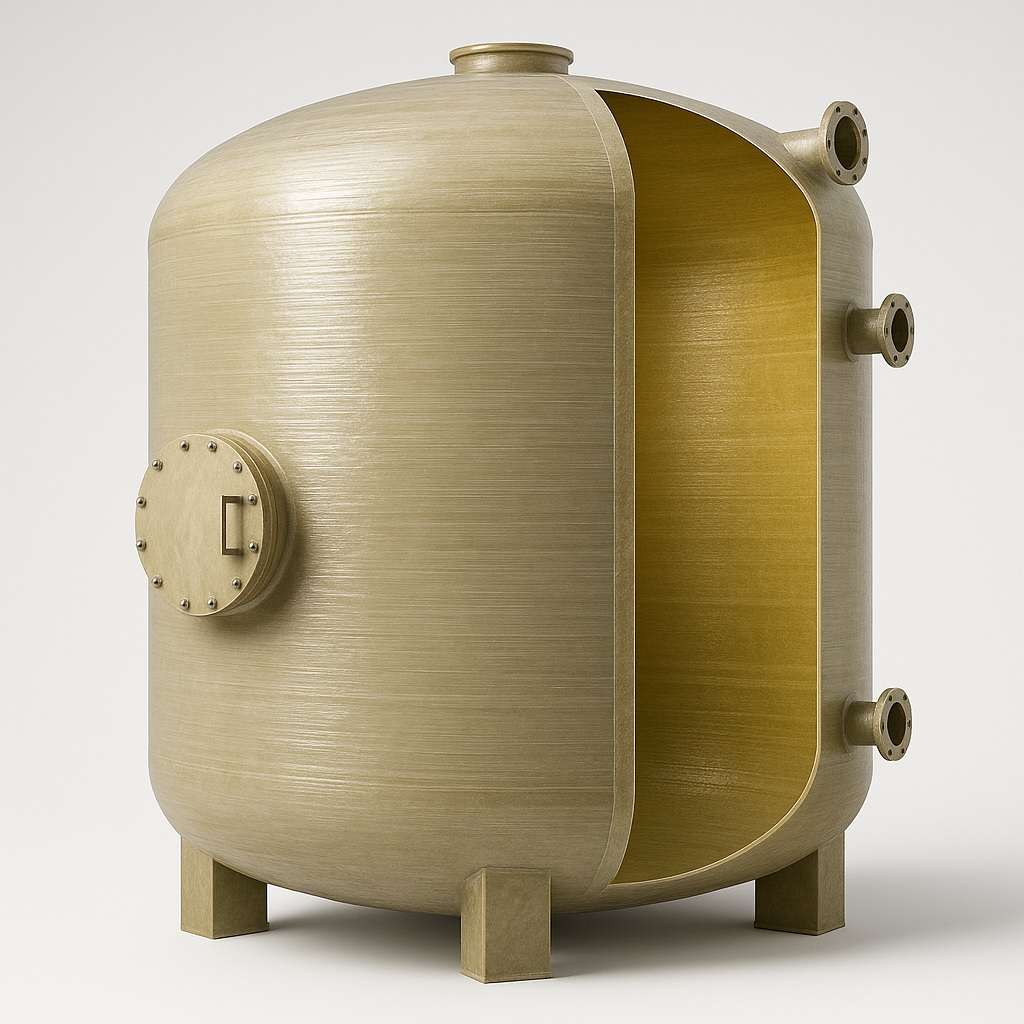
Advantages of FRP Composite Tanks
Key advantages of FRP tanks and composite vessels include:
Corrosion Resistance: FRP is immune to attack by acids, alkalis, salts and most aggressive chemicals. This means FRP tanks “do not rust or degrade” like metal in corrosive service. For example, FRP vessels safely contain sulfuric acid, sodium hypochlorite, caustic soda, chlorine, and many solvents that would rapidly corrode steel.
Lightweight Strength: High-performance FRP formulations and filament-wound construction yield an excellent strength-to-weight ratio. FRP tanks typically weigh a fraction of equivalent steel tanks. This reduces foundation loads and handling costs; a lighter tank is easier to ship, install (even underground), and move when needed. Despite being lighter, FRP tanks are engineered for equal or greater pressure performance, with uniform wall thickness eliminating the weak spots prone to cracking.
Design Flexibility: Composite tanks can be moulded into virtually any shape or size to fit space constraints or special process needs. The filament-winding and lay-up processes allow custom configurations (horizontal, vertical, large diameter, conical bottoms, etc.). FRP vessels can also be dual-laminated or lined with different resin or plastic layers (e.g. PVDF/FRP, PVC/FRP, PP/FRP) for extra chemical resistance. This versatility lets engineers optimize every tank for its application and site layout.
Durability and Low Maintenance: FRP tanks resist UV, weathering, and fatigue, giving them a long service life with minimal upkeep. Their nonconductive nature also prevents electrical corrosion and static-related issues. Operators report that fibreglass tanks require virtually no maintenance – no painting or cathodic protection is needed. The smooth, resin-rich liner means easy cleaning and no leaks from rust. Over the decades, the durable composite continues to “stand strong against the elements,” cutting replacement costs.
Applications in Chemical Storage and Processing
FRP composite vessels are ideal for chemical storage and process equipment in the most demanding environments. Typical applications include:
Acid and Alkali Storage: FRP’s chemical inertness benefits tanks holding sulfuric, nitric, phosphoric, hydrochloric acid and caustic solutions (sodium hydroxide). The resin system can be tailored (e.g., vinyl ester or speciality epoxies) to resist specific chemicals, making FRP a common choice for sulfuric acid tanks, caustic soda tanks, or acid waste bins.
Industrial Process Vessels: FRP reactors, scrubbers, clarifiers, and separators are used in industries where corrosive media, heat, or pressure are involved. FRP vessels safely handle aggressive mixtures and hot waste streams in petrochemical or mining plants. Their superior corrosion resistance means FRP towers and reactors often outlast steel even under continuous chemical attack.
Wastewater and Effluent: Corrosive wastewater from oil/gas wells or chemical plants is commonly stored in FRP tanks. Fibreglass is ideal for sewage or industrial effluent tanks because it can endure acids, organics and harsh cleaning agents without spalling. For example, FRP condensate tanks and scrubber vessels in refinery and gas treatment facilities leverage the material’s durability.
Outdoor and Extreme Conditions: Composite vessels are frequently installed outdoors or even underground, where they face UV exposure, freeze-thaw, and weather. FRP’s UV-resistant gel coats and inherently insulating structure protect the chemistry inside. FRP still performs when it freezes or cracks in cold climates or coastal plants (marine spray).
FRP “provides safe storage without the risk of corrosion” throughout these applications, enabling plants to operate more efficiently and with fewer safety issues than metal tanks.
Manufacturing Excellence by a Qualified Supplier
A qualified manufacturer of FRP tanks combines advanced engineering with precision manufacturing to deliver high-performance products suitable for industrial-grade chemical use.
Production Capabilities
- Filament Winding Technology: Automated CNC-controlled winding ensures consistent fibre placement, optimal wall thickness, and structural uniformity.
- Custom Mould Fabrication: Allows for high-volume or custom one-off production tailored to the end user’s dimensional and performance requirements.
- Dual Laminate Construction enables the integration of thermoplastic liners (e.g., PVDF, PP, ECTFE) for applications demanding extreme chemical resistance.
Quality Control and Certification
A reputable FRP tank manufacturer will have rigorous quality control protocols, including:
- Raw material verification and resin traceability
- In-process inspections during lay-up, curing, and post-forming
- Final pressure testing, vacuum testing, and leak detection
- Compliance with international standards like ASTM D3299, ASME RTP-1, and ISO 9001
By maintaining strict process discipline and documentation, these manufacturers ensure every composite vessel meets its design specifications and safety performance targets.
Conclusion
FRP tanks and composite vessels are a proven, high-performance option for chemical processing facilities seeking a reliable, long-lasting solution to corrosion and maintenance challenges. Their superior resistance to aggressive media, lightweight structure, and adaptable design make them ideal for modern industrial operations. When sourced from a qualified manufacturer, these tanks provide years of dependable service with minimal intervention, delivering operational efficiency and long-term cost savings.
Whether your plant needs chemical storage, effluent handling, or integrated process solutions, FRP technology is a durable and forward-looking investment.

